Is Yoga Dying?
Or Has It Simply Taken Its Last Savasana?
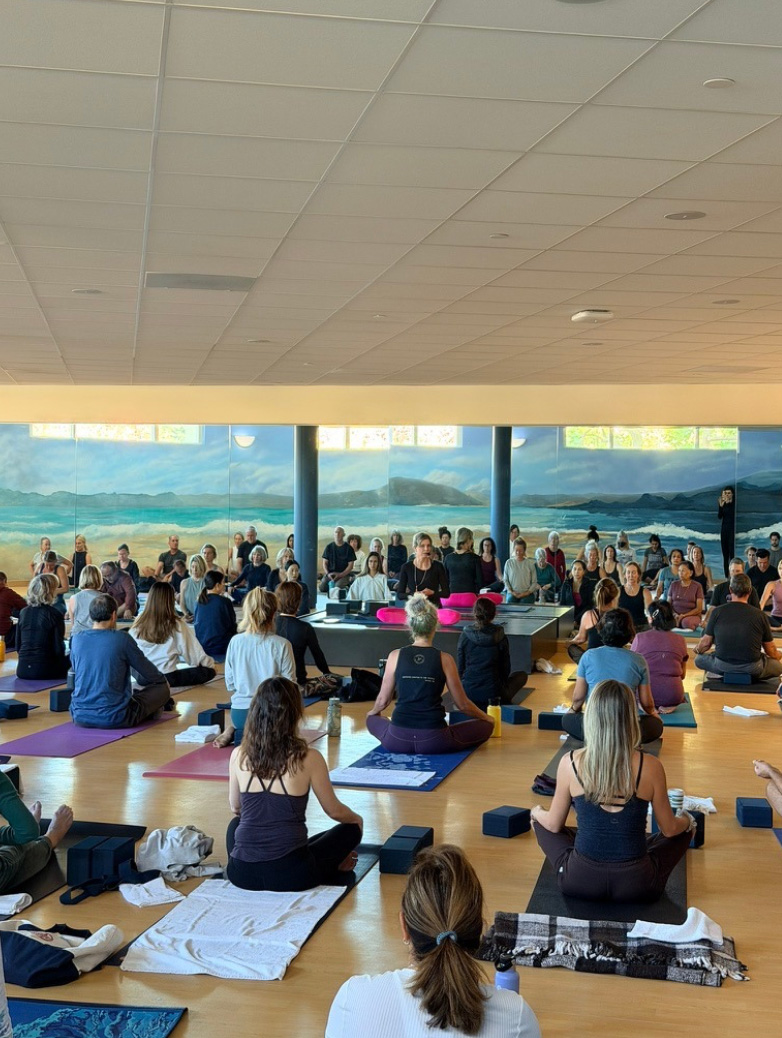
Teaching at a dedicated yoga room inside a fitness resort.
I’ve been teaching yoga for nearly forty years, and lately I’ve found myself asking a question I never imagined I would ask:
Is yoga dying?
Not disappearing.
Yoga is everywhere.
It’s in health clubs and community centers, boutique studios and resorts, schools and workplaces, apps and streaming platforms. There are more styles, more teachers, more teacher trainings and more ways to practice than I could ever have imagined when I began.
And statistically, people haven’t stopped doing yoga. Millions of Americans still practice, and yoga remains one of the most popular forms of mind-body exercise.
Yet something feels different.
I see it in studios across the country.
I see it in classes.
I see extraordinary teachers with decades of experience teaching fewer classes or leaving altogether.
And I see people who once seemed committed to a lifelong yoga practice moving on to Pilates, strength training, biohacking, longevity protocols, cold plunges, breathwork or simply whatever is next.
So perhaps the question isn’t only, “Is yoga dying?” Perhaps it is:
Has yoga taken its last Savanna?
or even more importantly:
Where have all the yogis gone?
I’ve Seen This Cycle Before
I have the benefit of having spent almost four decades inside the fitness and wellness world. When I began my career, gyms were primarily places where people lifted weights. Group fitness as we know it today barely existed.
Then aerobic studios began popping up.
They were exciting. New. Social. Packed.
Before long, health clubs realized that people wanted group exercise and began building large group fitness programs of their own.
Eventually, many of those independent aerobic studios disappeared.
Years later, when I was COO and head of programming for a successful chain of Southern California athletic clubs, I helped bring yoga into our clubs. At the time, that was unusual. We received media attention because yoga simply wasn’t something most mainstream health clubs offered. And what we brought in was traditional yoga.
Yes, we practiced postures. But the postures were not the whole point.
There was breath. There was concentration. There was philosophy. There was meditation. There was self-study.
There was the understanding that what happened on the mat was preparation for how we lived when we stepped off it.
Then yoga exploded.
Studios began opening everywhere. Gyms added yoga. Community centers added yoga. Resorts added yoga. Teacher trainings multiplied. Online platforms made thousands of classes available instantly. And in many ways, that was wonderful.
Yoga became accessible to millions of people who might otherwise never have encountered it.
But I think something else happened at the same time.
As yoga became broader, it sometimes became thinner.
When Yoga Becomes Just Another Workout
I want to be careful here.
I am not suggesting that yoga belongs to a select few.
Quite the opposite.
I have spent my career making yoga accessible to real people in real bodies.
There is no pose above or below another.
There is no requirement that someone be flexible, spiritual, young, thin or able to stand on their head in order to practice yoga. Accessibility is one of the greatest gifts of yoga’s evolution. But accessibility and dilution are not the same thing.
Somewhere along the way, yoga often became another option on a fitness schedule.
Monday Pilates.
Tuesday yoga.
Wednesday strength.
Thursday cycling.
Friday, whatever we saw on Instagram.
There is nothing inherently wrong with any of those things.
Movement is good. Strength is important. Trying new things can be wonderful.
But yoga was never intended to be simply another exercise modality.
It was a path.
And a path asks something different of us.
It asks us to stay.
We Have Never Had More Wellness
The change in yoga is happening inside an even bigger cultural shift.
The wellness industry has become enormous.
The Global Wellness Institute valued the worldwide wellness economy at approximately $6.8 trillion in 2024, more than double its size in 2013.
We have never had more ways to improve ourselves. Sleep trackers. Glucose monitors. Supplements. Cold plunges. Infrared saunas.
Recovery boots. Meditation apps. Longevity protocols. Peptides. Morning routines. Evening routines.
Ten things to do before breakfast.
Five things never to do after 6 p.m.
And every time we open our phones, someone is telling us there is one more thing we should be doing if we really care about our health.
At some point, wellness itself begins to become exhausting.
I call it wellness fatigue.
We are so busy trying to optimize ourselves that we may be losing the ability to simply inhabit ourselves.
And that is where I think yoga has something enormously important to say.
Eat • Move • Think.
My three pillars of sustainable wellness and resilient movement.